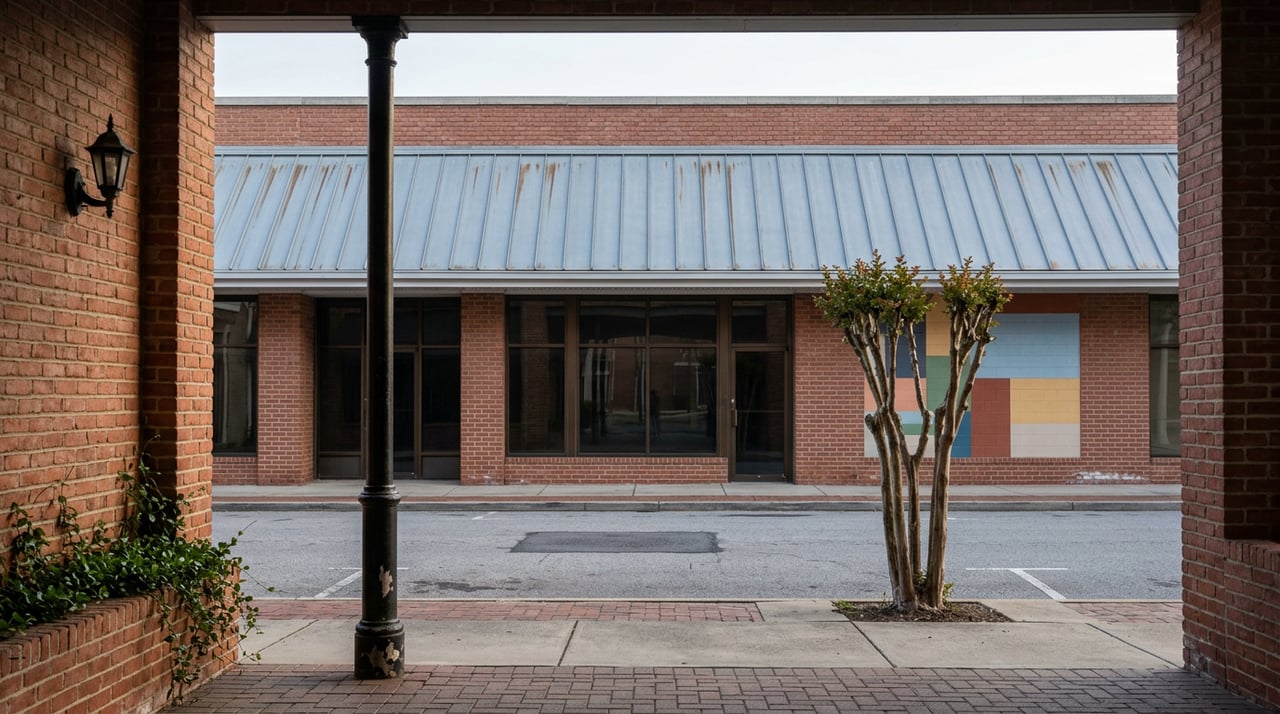
The Cotton District on a non-game Saturday morning looks almost sleepy. A few regulars linger over coffee, someone walks a dog past the murals, and the loudest thing on the block might be a delivery truck idling near Two Brothers Smoked Meats before the lunch rush. Seven days later, the same three blocks are wall to wall with maroon, the patio at Bin 612 has a line stretching past the corner, and Bulldog Burger Co. is running a to-go window that didn't exist the week before. Same neighborhood, same storefronts, completely different town.
Anyone who has lived in Starkville through a football season already knows this much. What most people haven't sat down and mapped is how those two Saturdays actually fall across the calendar, because they don't alternate the way most residents assume. This fall, they cluster.
The homestand isn't spread out. It's stacked.
Mississippi State plays seven home games at Davis Wade Stadium at Scott Field in 2026, a stadium that seats 60,311. The instinct is to picture that spread evenly across the season, one loud Saturday, one quiet one, back and forth through November. That's not what the schedule does.
The Bulldogs open the season at home against Louisiana-Monroe in the first week of September, then leave town for two straight road trips, at Minnesota and at South Carolina. That gives downtown its first genuinely quiet back-to-back stretch of the fall before the crowd returns. Home games against Missouri (September 26) and Alabama (October 3) land in consecutive weeks, which means the Cotton District effectively runs on football time for a full two-week stretch with no break in between. Then comes the bye week on October 10, immediately followed by a road game at LSU on October 17, which hands downtown a second quiet stretch, this one also two weekends long, right in the middle of the season.
Oklahoma comes to Starkville October 24, sandwiched by another road trip, at Texas on October 31. Then the calendar does something it hasn't done all season: three home Saturdays in a row. Vanderbilt (November 7), Auburn (November 14), and Tennessee Tech (November 21) close out the home slate as consecutive weekends, the longest uninterrupted homestand of the fall, right as the weather actually turns. The season itself doesn't end at home. It ends on the road in Oxford against Ole Miss for the Egg Bowl on November 28.
So the real shape of the fall isn't an even trade-off. It's two home games back to back in late September and early October, a two-week gap, one more home Saturday in late October bookended by road trips, and then three home Saturdays in a row to close out November. If you're planning anything downtown this season, the three-in-a-row November stretch is the one to build around, not the season opener.
What actually changes on a home Saturday
The Cotton District is built to absorb this. It's a compact, walkable grid of restaurants, bars, and apartments a short walk from the stadium, and on a home Saturday it functions as the informal front porch for the entire gameday operation. Bin 612, Two Brothers Smoked Meats, and Bulldog Burger Co. all shift into pregame mode hours before kickoff, and the sidewalks that were empty the week before fill with people moving toward The Junction, the tailgating grounds directly across from the stadium.
Part of that migration includes the Dawg Walk, the pregame tradition where the football team and the Famous Maroon Band move through the crowd on their way into Davis Wade Stadium. It's one of the fixed points of a home Saturday, timed tightly enough that regulars plan their lunch or their parking around it rather than the kickoff clock itself.
There's a smaller, unwritten tradition tied to all of this that longtime residents already know and newcomers usually learn the hard way: you're not supposed to buy your own first cowbell. It's meant to be given to you, typically by someone already rooted in the community, which makes the cowbell less a souvenir and more a small marker of having been formally welcomed in.
The sidewalks themselves are mid-change this season
There's a complication layered on top of all this that has nothing to do with football. Downtown Starkville is in the middle of a streetscape project focused on pedestrian access, and part of that work involves raising sections of the street to meet sidewalks that were originally built high to accommodate horse-drawn carriages more than a century ago. For anyone walking the same three or four blocks every home Saturday, that means the routes between the Cotton District and the stadium aren't fixed this fall the way they usually are. A path that was clear last season might be narrowed, rerouted, or temporarily uneven this year, which is worth knowing before you're threading a stroller or a cooler through downtown on a game morning.
The quiet Saturdays aren't nothing
It's tempting to treat the non-home weekends as dead time, but that undersells them. Early in the fall, before its season winds down, the Starkville Community Market at Fire Station Park still gives the off-week mornings their own rhythm, a slower one built around produce stands and conversation rather than tailgates. It's the closest thing Starkville has to a control group for its own personality, the version of downtown that exists when the stadium isn't pulling everyone's Saturday into its orbit.
That contrast is really the point. Starkville isn't a town that becomes a college town on football Saturdays and reverts the rest of the time. It's a town that contains both versions simultaneously, and the calendar this fall just happens to bunch them into more distinct stretches than usual, two crowded weeks, a two-week lull, one loud weekend surrounded by road trips, then three loud weekends in a row to close things out.
Planning around the actual pattern
If you live downtown or near the Cotton District, the practical takeaway isn't "football season is busy." It's that the calendar this year gives you two genuinely long quiet windows, the early two-week road stretch in mid-September and the bye-plus-road-trip stretch in mid-October, before the season locks into its longest home stretch in November. Grocery runs, dog walks, and anything requiring an actual parking spot downtown are easier to plan around those specific gaps than around a vague sense of "not gameday."
The streetscape work adds a second layer worth tracking through the season. If a normal walking route downtown gets rerouted mid-project, that's not a permanent change, it's a construction-season detour, and it's the kind of detail that only shows up if you're paying attention to what's actually happening on the ground rather than reading a general visitor's guide to the town.
Starkville's identity as a college town isn't in question. What changes year to year is the shape of the calendar underneath it, and this fall's shape rewards residents who know when the loud stretches actually land and when they don't.
For those of us who call the Golden Triangle home, keeping an eye on the small shifts in a neighborhood, a new business, a construction project, a schedule quirk, is part of what makes this market worth understanding closely. If you're thinking about your own place in Starkville or anywhere else in the Golden Triangle, Delta-Gulf Real Estate Corporation would be glad to talk through what's happening on the ground. Explore Our Properties.
