Ask someone unfamiliar with the Golden Triangle to picture small-town Mississippi, and they'll draw you a Main Street: a bank, a post office, a row of brick storefronts with a name like Caledonia's own, founded in the 1820s by Scots-Irish settlers who opened a post office here in December 1836 and had a bank and a hat factory running by 1840. That's the postcard. It's also not where Caledonia actually spends its Saturdays.
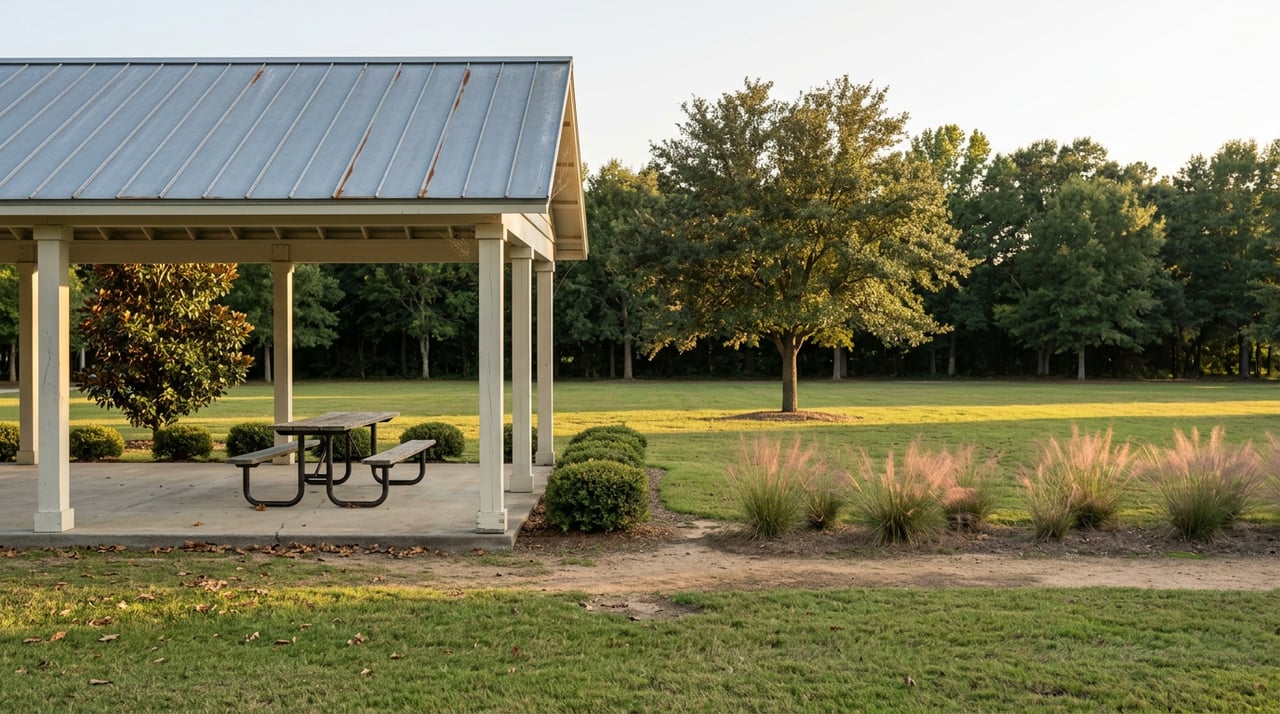
The real gravitational pull of this town sits two miles off Main Street, down Wolfe Road, at a public park that runs a splash pad, a disc golf course, and four lit baseball fields on money the town has to fight for every few years. Understanding how that fight works, and who's actually funding the park, explains more about daily life here than any walk down Main Street will.
A park funded by an argument nobody outside Lowndes County hears
Caledonia doesn't pay for Ola J. Pickett Park out of a town recreation budget in any straightforward sense. The money comes from a 2 percent tourism tax collected on prepared food and beverage sales across Lowndes County, and by law that revenue has to go back into recreation. In 2022, the Lowndes County Board of Supervisors approved a $50,000 allocation to the park for an equipment shed, HVAC for the concession booths, electrical work, fencing, a flagpole, and a playground.
That approval wasn't automatic. District 5 Supervisor Leroy Brooks pushed back on the arrangement, pointing out that the county was also building a multi-million dollar sportsplex and questioning whether Caledonia should keep getting a direct allocation on top of that. District 1 Supervisor Harry Sanders, who represents Caledonia, argued the opposite: since the tourism tax is collected in the towns of Caledonia, Crawford, and Artesia, the money collecting there should flow back to recreation in those same towns. The board voted unanimously to fund it anyway, but the tension was real, and it tells you something the town doesn't advertise: the park's existence is a small, recurring political negotiation, not a settled line item.
What's actually behind the fence
The park earns the fight. On any given weekend, Ola J. Pickett Park is doing several jobs at once:
- A splash pad, with a pavilion that the town deliberately keeps open to walk-up use all summer. Town rules block the pavilion from being reserved for private events from the Thursday before Memorial Day through Labor Day, which means for the entire stretch of hot weather, it stays a first-come, no-reservation amenity rather than something you have to book.
- A disc golf course, low-key enough that it hasn't picked up online reviews yet, but real and mapped for anyone who plays.
- Four baseball fields that got a lighting upgrade in 2024, when the town put out a sealed bid for LED sports lights to replace the existing fixtures across all four fields, a lump-sum project overseen by Mayor Betty Darnell's office.
The baseball side of the park has been running for over two decades. In 2022, when Caledonia Parks and Recreation marked its 20th year, six of the men who helped start youth baseball in town, Steve Honnoll, Kevin Brown, Tony Hopper, Andy Hicks, Wayne Fairchild, and Mike Savage, came back to the same fields for the anniversary. Fairchild summed up why the park matters more than its size suggests:
"Each neighbor, grandmother, grandfather that lives here doesn't have to drive 15 minutes."
That's the actual function of the place. It's not scenery. It's proximity for people who can't or don't want to drive.
Main Street keeps the name plate, not the gravity
None of this is to say Main Street is empty. Town Hall sits at 754 Main Street, and that's where the Mayor and Board of Alderpersons hold their regular meetings, where the town's business actually gets conducted on paper. The Caledonia Historic District is there too, a reminder of the same 1840s commercial core that had a bank and a hat factory before the Civil War.
What Main Street doesn't have much of anymore is food. If you're looking for a sit-down dinner or a broad range of takeout, most of it is a drive away. A search of restaurants near Caledonia's ZIP code turns up a long list of options, but nearly all of them sit 12 to 22 miles out, in Columbus, West Point, or Amory. Inside town limits, the clearest example that keeps coming up in reviews is Mi Toro's Mexican, a family-run spot that's actually located in Caledonia rather than just nearby. It's a good marker for what dining in town looks like: a handful of true local options, and everything else means getting in the car.
That split matters for how residents actually structure a weekend. If you want variety, you drive out. If you want to see your neighbors without planning around it, you go the other direction, out Wolfe Road to the park.
The other bookend: two farms holding the ends of town
Caledonia has a second, less obvious anchor at each edge of town, and it says something about how rural the area still is even with Columbus fifteen minutes away. On Highway 12 East, BACK40 Petting Farm has been a fixture long enough to show up as a listed tourist attraction for the area. On the opposite side of town, on Cal Kolola Road just east of Kolola Springs Baptist Church, a newer operation called Patch of Heavens Farm Rescue and Exotic was taking shape as of a 2023 report. Owner Michele Griffin had been building toward it since 2021, starting with Clyde, a camel she bought in 2017, and was working through a list of fencing requirements, including reinforced double fencing for a small kangaroo enclosure, with an eye toward opening by early summer.
Two petting farms bracketing a town of roughly 1,100 people isn't typical, even for rural Mississippi. It's a sign that the working, agricultural character of the area around Caledonia hasn't been zoned or paved out of it the way it has in a lot of small towns that sit this close to a regional hub like Columbus.
What this adds up to
None of these pieces work in isolation. The park exists because a county tax fight keeps going Caledonia's way more often than not. The baseball fields stay lit because the town keeps bidding out upgrades rather than letting them go dark. The splash pad stays open to anyone because the rules are written that way on purpose. Main Street holds the paperwork and the history, but the actual traffic, the people who show up without an invitation, ends up at the park or out toward one of the farms on either edge of town.
If you already live here, none of this is a discovery exactly, but it's worth having the mechanism spelled out: the reason Caledonia feels smaller and more connected than its population count suggests isn't an accident of geography. It's a park that keeps winning its funding fight, a handful of restaurants that force you to choose between staying local and driving out, and two farms that remind you this is still agricultural land, not a suburb that happens to have a Main Street sign.
At Delta-Gulf Real Estate Corporation, we spend a lot of time in towns like this across the Golden Triangle, and the ones that hold together tend to have exactly this kind of quiet, contested infrastructure behind them. If you're curious what else shapes daily life in Caledonia, or anywhere else in the Golden Triangle, Explore Our Properties and see what's currently on the market.
